

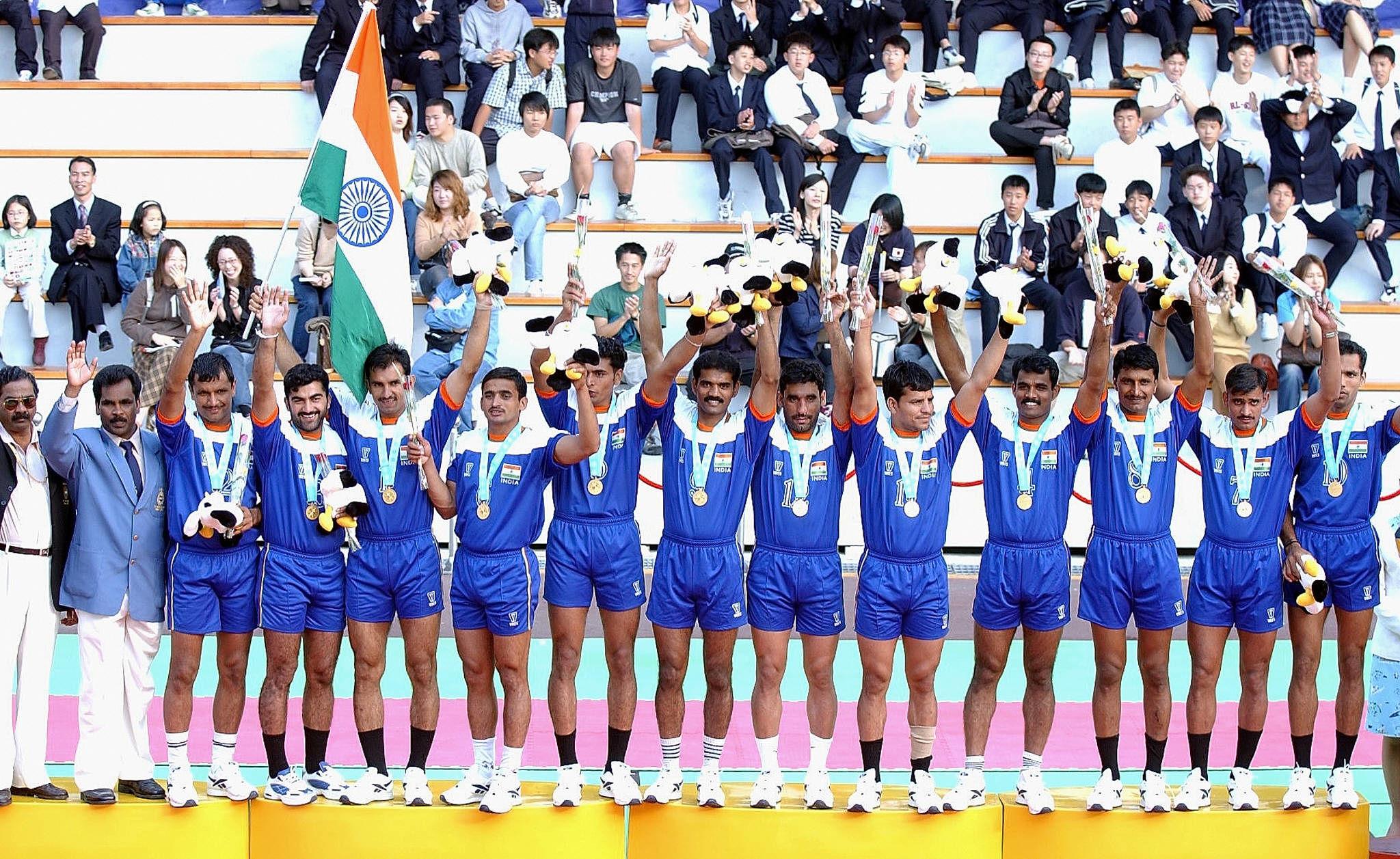
The 2002 Asian Games in Busan, South Korea, marked the beginning of a new century in India’s Asian Games journey.
After winning 35 medals in Bangkok in 1998, India returned with another strong campaign, producing 36 medals and finishing 7th in the medal table.
India’s final tally was:
11 Gold | 12 Silver | 13 Bronze | 36 Medals
The 2002 Games also witnessed the emergence of several athletes who would become important figures in Indian sport over the following years.
From Anju Bobby George’s long-jump gold and K. M. Beenamol’s outstanding athletics campaign to Shiv Kapur’s historic golf triumph, Leander Paes and Mahesh Bhupathi’s tennis gold, and India’s continuing dominance in kabaddi, Busan offered plenty of memorable moments.
Athletics Once Again Leads the Way
Athletics was India’s biggest medal-producing sport in Busan.
The Indian athletics team won 17 medals — 7 gold, 6 silver and 4 bronze — accounting for almost half of India’s entire medal haul.
The gold-medal winners were:
- Saraswati Saha — Women’s 200m
- K. M. Beenamol — Women’s 400m
- Sunita Rani — Women’s 1500m
- Neelam Jaswant Singh — Women’s Discus Throw
- Anju Bobby George — Women’s Long Jump
- Women’s 4×400m Relay Team
- Bahadur Singh Sagoo — Men’s Shot Put
Anju Bobby George Makes History
One of the defining performances of Busan 2002 came from Anju Bobby George.
She won gold in the women’s long jump, becoming one of the most prominent names in Indian athletics at the beginning of the new millennium.
Her success would become an important chapter in a career that eventually took her to the Olympic podium, where she won India’s first World Athletics Championships medal in 2003.
At Busan, however, the focus was on a breakthrough Asian Games gold.
K. M. Beenamol’s Double Gold
K. M. Beenamol was another major star of India’s athletics campaign.
She won the women’s 400m gold and was part of the Indian women’s 4×400m relay team that also won gold.
She also won silver in the individual 400m event according to the official Indian Olympic Association record.
The women’s athletics team was particularly successful in Busan, with Indian women accounting for several of the country’s most important gold and silver medals.

Sunita Rani’s Controversial Chapter
Sunita Rani won gold in the women’s 1500m and bronze in the 5000m.
However, her Busan campaign became embroiled in a doping controversy after the Games.
Her medals were subsequently reinstated following a successful appeal. The reinstatement changed India’s position in the final medal standings, moving the country from 8th to 7th.
It is an important part of the Busan story because the final Indian medal tally cannot be understood without this episode.
Shiv Kapur’s Historic Golf Gold
One of the most significant developments in Busan came outside India’s traditional medal-winning sports.
Shiv Kapur won gold in the men’s individual golf event.
Golf was still a relatively new addition to India’s Asian Games medal story, and Kapur’s victory gave India another individual Asian Games champion.
His gold demonstrated the growing breadth of India’s sporting programme beyond athletics, hockey, wrestling and shooting.
Tennis Continues to Shine
Tennis remained another important contributor.
Leander Paes and Mahesh Bhupathi won gold in the men’s doubles.
Paes also won a silver medal in mixed doubles alongside Manisha Malhotra, while Paes and Sania Mirza won bronze in mixed doubles.
The other Indian bronze came through Vishal Uppal and Mustafa Ghouse in men’s doubles.
The Busan campaign further established Indian tennis as a regular Asian Games medal-producing sport.
Cue Sports Produces Three Medals
India also enjoyed a strong campaign in cue sports.
Yasin Merchant and Rafat Habib won gold in men’s doubles.
Geet Sethi and Alok Kumar won silver in English billiards doubles, while Sethi added a bronze in the individual event.
That gave India three medals in cue sports, including one gold.
Kabaddi Dominance Continues
India’s men’s kabaddi team continued its remarkable Asian Games run.
After winning gold when kabaddi became a medal sport in 1990, and successfully defending the title in 1994 and 1998, India won the men’s gold again in Busan.
It was therefore India’s fourth consecutive Asian Games kabaddi gold.
Kabaddi had become one of the clearest examples of India’s sustained dominance at the Asian Games.
Hockey Returns to the Podium
The Indian men’s hockey team won silver in Busan.
While India could not reclaim the gold medal, the result continued the country’s remarkable record of appearing on the Asian Games hockey podium.
Hockey remained one of India’s most consistent sources of medals throughout the history of the Games.
Shooting and Sailing Add More Medals
Shooting contributed two silver medals.
The men’s trap team of Manavjit Singh Sandhu, Mansher Singh and Anwer Sultan won silver.
The women’s 10m air rifle team of Anjali Bhagwat, Deepali Deshpande and Suma Shirur also won silver.
Sailing contributed three medals:
- Nitin Mongia — Silver, Open OK Dinghy
- Rajesh Choudhary — Bronze, Laser Radial
- Aashim Mongia & Mahesh Ramchandran — Bronze, Enterprise
India’s Other Medal Winners
India also won bronze medals in:
- Taekwondo — Surendra Bhandari
- Wrestling — Palwinder Singh Cheema
- Rowing — Men’s Coxless Four
- Equestrian — Team Eventing
These medals reflected the increasingly diverse nature of India’s Asian Games campaign.
India’s 36 Medals at Busan 2002
Gold Medals — 11
| No. | Athlete/Team | Sport | Event |
|---|---|---|---|
| 1 | Saraswati Saha | Athletics | Women’s 200m |
| 2 | K. M. Beenamol | Athletics | Women’s 400m |
| 3 | Sunita Rani | Athletics | Women’s 1500m |
| 4 | Neelam Jaswant Singh | Athletics | Women’s Discus Throw |
| 5 | Anju Bobby George | Athletics | Women’s Long Jump |
| 6 | Manjeet Kaur, Soma Biswas, K. M. Beenamol, Jincy Philip | Athletics | Women’s 4×400m Relay |
| 7 | Bahadur Singh Sagoo | Athletics | Men’s Shot Put |
| 8 | Indian Men’s Kabaddi Team | Kabaddi | Men’s Kabaddi |
| 9 | Shiv Kapur | Golf | Men’s Individual |
| 10 | Leander Paes & Mahesh Bhupathi | Tennis | Men’s Doubles |
| 11 | Yasin Merchant & Rafat Habib | Cue Sports | Men’s Doubles |
Silver Medals — 12
| No. | Athlete/Team | Sport | Event |
|---|---|---|---|
| 1 | K. M. Beenamol | Athletics | Women’s 400m |
| 2 | Madhuri Singh | Athletics | Women’s 800m |
| 3 | Bobby Aloysius | Athletics | Women’s High Jump |
| 4 | Soma Biswas | Athletics | Women’s Heptathlon |
| 5 | K. M. Binu | Athletics | Men’s 800m |
| 6 | Purakkotte Ramachandran, Manoj Lal, Satvir Singh, Bhupinder Singh | Athletics | Men’s 4×400m Relay |
| 7 | Geet Sethi & Alok Kumar | Cue Sports | Men’s English Billiards Doubles |
| 8 | Manavjit Singh Sandhu, Mansher Singh & Anwer Sultan | Shooting | Men’s Trap Team |
| 9 | Anjali Bhagwat, Deepali Deshpande & Suma Shirur | Shooting | Women’s 10m Air Rifle Team |
| 10 | Nitin Mongia | Sailing | Open OK Dinghy |
| 11 | Indian Men’s Hockey Team | Hockey | Men’s Hockey |
| 12 | Manisha Malhotra & Mahesh Bhupathi | Tennis | Mixed Doubles |
Bronze Medals — 13
| No. | Athlete/Team | Sport | Event |
|---|---|---|---|
| 1 | Sunita Rani | Athletics | Women’s 5000m |
| 2 | J. J. Shobha | Athletics | Women’s Heptathlon |
| 3 | Shakti Singh | Athletics | Men’s Shot Put |
| 4 | Anil Kumar | Athletics | Men’s Discus Throw |
| 5 | Vishal Uppal & Mustafa Ghouse | Tennis | Men’s Doubles |
| 6 | Leander Paes & Sania Mirza | Tennis | Mixed Doubles |
| 7 | Geet Sethi | Cue Sports | Men’s English Billiards Singles |
| 8 | Palwinder Singh Cheema | Wrestling | Men’s 120kg Freestyle |
| 9 | Jenil Krishnan, Inderpal Singh, Roshan Lal Paulose & Pandari Kunnel | Rowing | Men’s Coxless Four |
| 10 | Indrajit Lamba, Bhagirath Singh, Rajesh Pattu, Deep Kumar Ahlawat | Equestrian | Team Eventing |
| 11 | Rajesh Choudhary | Sailing | Open Laser Radial |
| 12 | Aashim Mongia & Mahesh Ramchandran | Sailing | Open Enterprise |
| 13 | Surendra Bhandari | Taekwondo | Men’s 58kg |
1998 to 2002: India Maintains Its Momentum
| Edition | Gold | Silver | Bronze | Total | Rank |
|---|---|---|---|---|---|
| Bangkok 1998 | 7 | 11 | 17 | 35 | 9th |
| Busan 2002 | 11 | 12 | 13 | 36 | 7th |
The improvement was significant.
India increased its gold-medal tally from 7 to 11, added one more silver medal and increased its overall medal count from 35 to 36.
More importantly, India moved from 9th to 7th in the medal table.
The 2002 campaign also showed greater diversification. Athletics remained the backbone with 17 medals, but India won gold in kabaddi, golf, tennis and cue sports as well.
Why Busan 2002 Matters
The 2002 Asian Games represented an important transition in Indian sport.
The country was still relying heavily on athletics, but the medal-winning base was becoming broader.
Anju Bobby George was emerging as a major force in athletics.
K. M. Beenamol became one of the leading Indian women runners of her generation.
Shiv Kapur showed India’s potential in golf.
Leander Paes and Mahesh Bhupathi continued India’s success in tennis.
Kabaddi remained India’s most dominant team sport at the Asian Games.
And athletes such as Anjali Bhagwat, Manavjit Singh Sandhu and others were helping strengthen India’s presence in shooting.
Busan 2002 therefore sits at an important point in India’s Asian Games history — between the recovery of the 1990s and the much larger medal hauls that would follow.
Four years later, India would travel to Doha 2006, where it would produce its biggest Asian Games medal tally since New Delhi 1982.
[…] 2006 Asian Games in Doha, Qatar, marked a major step forward in India’s Asian Games […]