


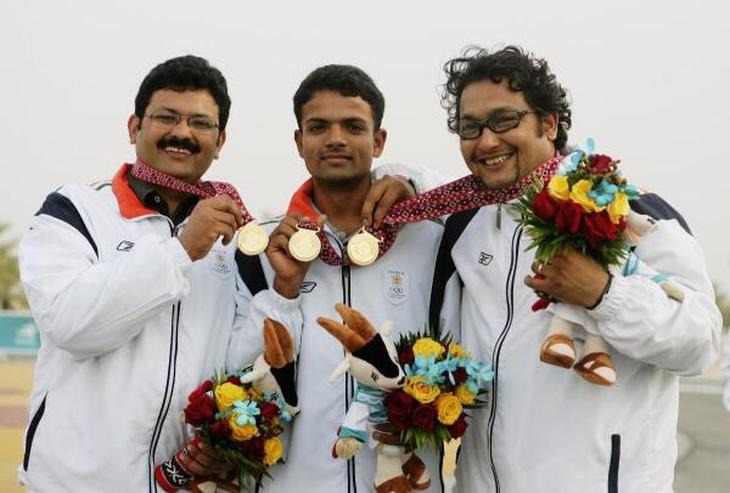
The 2006 Asian Games in Doha, Qatar, marked a major step forward in India’s Asian Games journey.
Four years after winning 36 medals at Busan, India returned with a significantly larger haul.
India finished 8th in the medal table with:
10 Gold | 17 Silver | 26 Bronze | 53 Medals
The 53-medal haul was India’s biggest since the 1982 Asian Games in New Delhi, and represented an increase of 17 medals from the previous edition. India also expanded its medal-winning base, with shooting, tennis, chess, cue sports, wrestling and rowing all making significant contributions.
At the centre of the campaign was one of India’s most accomplished shooters.
Jaspal Rana won three gold medals.
But Doha 2006 was about much more than one athlete. It was also the Games where Koneru Humpy emerged as a double gold medallist, Pankaj Advani announced himself on the Asian Games stage, and Sania Mirza and Leander Paes continued India’s rise in tennis.
Shooting Becomes India’s Biggest Medal Sport
For much of India’s Asian Games history, athletics had been the country’s principal medal-producing sport.
Doha was different.
Shooting produced 14 medals — 3 gold, 5 silver and 6 bronze — making it India’s most successful sport at the Games.
And the leading figure was Jaspal Rana.
Jaspal Rana’s Three Golds
Rana won gold in:
- Men’s 25m Centre Fire Pistol
- Men’s 25m Standard Pistol
- Men’s 25m Centre Fire Pistol Team

He was joined by Samaresh Jung and Vijay Kumar in the team event.
Rana’s three gold medals made him one of the standout Indian performers of the entire Games. His Doha campaign further established his status as one of India’s great Asian shooting champions.
India’s shooting squad also collected silver medals in men’s trap, men’s trap team, men’s double trap team, women’s 10m air pistol team and men’s 25m standard pistol team.
Bronze medals came in men’s double trap, men’s 50m rifle 3 positions, men’s 25m rapid fire pistol, men’s and women’s 10m air rifle teams, and the men’s 50m rifle 3 positions team.
Koneru Humpy and India’s Chess Breakthrough
Doha 2006 was also an important edition for Indian chess.
Koneru Humpy won two gold medals.
She won the women’s rapid individual title and was part of India’s victorious mixed team classical squad alongside Krishnan Sasikiran and Pendyala Harikrishna.

Chess therefore contributed two gold medals to India’s campaign.
For Humpy, the Games represented another major step in a career that had already established her as one of the world’s leading women chess players.
Pankaj Advani’s Asian Games Gold
Another young Indian star made his mark in Doha.
Pankaj Advani won gold in men’s English billiards singles.
It was an important moment in the career of an athlete who would go on to become one of the most successful cue-sports players in Indian history.

India also won silver through Ashok Shandilya in billiards singles.
The country added two bronze medals in cue sports — the men’s billiards doubles combination of Geet Sethi and Ashok Shandilya, and the men’s snooker team of Aditya Mehta, Yasin Merchant and Rupesh Shah.
Cue sports therefore contributed four medals, including one gold.
Tennis Continues India’s Golden Run
Indian tennis once again delivered two gold medals.
Leander Paes and Mahesh Bhupathi won the men’s doubles title.
Paes then teamed up with a young Sania Mirza to win the mixed doubles gold.
Sania also won silver in women’s singles, while the Indian women’s team of Ankita Bhambri, Isha Lakhani, Sania Mirza and Shikha Uberoi won silver.
Tennis contributed four medals in total:
2 Gold | 2 Silver
It was another strong showing from a sport that had become an important part of India’s Asian Games success.
Athletics: The Women’s 4×400m Golden Run
Athletics did not dominate India’s medal tally in Doha in the way it had in earlier editions, but it still produced nine medals.
India won one gold, four silver and four bronze medals in athletics.
The gold came in the women’s 4×400m relay.
The Indian quartet of:
- Sathi Geetha
- Manjeet Kaur
- Chitra Soman
- Pinki Pramanik
won the final in 3:32.95, ahead of Kazakhstan and China.
India also collected silver medals through:
- Manjeet Kaur — 400m
- Anju Bobby George — Long Jump
- Soma Biswas — Heptathlon
- Men’s 4×400m Relay
Bronze medals came through Sinimol Paulose, O. P. Jaisha, J. J. Shobha and Krishna Punia.
For Anju Bobby George, Doha brought another Asian Games medal after her gold at Busan 2002.
Kabaddi Remains India’s Constant
India’s men’s kabaddi team continued its extraordinary Asian Games dominance.
After winning gold in 1990, 1994, 1998 and 2002, India again won the men’s kabaddi gold medal in Doha.
It was India’s fifth consecutive Asian Games kabaddi title since the sport became a medal event in 1990.
Kabaddi had by then become one of the clearest examples of India’s sustained dominance at the Asian Games.
Wrestling Produces Six Medals
Wrestling continued to provide India with a steady stream of medals.
India won six wrestling medals:
- Geetika Jakhar — Silver, women’s 63kg freestyle
- Vinayak Dalvi — Bronze, men’s 55kg Greco-Roman
- Alka Tomar — Bronze, women’s 55kg freestyle
- Yogeshwar Dutt — Bronze, men’s 60kg freestyle
- Sushil Kumar — Bronze, men’s 66kg freestyle
- Palwinder Singh Cheema — Bronze, men’s 120kg freestyle
Among them were two athletes whose later careers would become especially significant.
Yogeshwar Dutt and Sushil Kumar were still at the beginning of their journeys.
Both would go on to become Olympic medallists for India.
Rowing and Sailing Add to the Haul
India also produced strong performances in rowing and sailing.
Bajranglal Takhar won silver in men’s single sculls.
The men’s coxless four also won silver, while Bijender Singh and Kiran Yalamanchi won bronze in lightweight double sculls.
Sailing produced two medals:
- Men’s Beneteau First 7.5 — Silver
- Rajesh Choudhary — Bronze, Laser Radial
These results reflected the increasingly diverse nature of India’s Asian Games medal programme.
Santhi Soundarajan: A Medal and a Controversy
One of the most difficult stories from Doha involved Indian middle-distance runner Santhi Soundarajan.
Soundarajan originally won silver in the women’s 800m.
However, after the Games, she was subjected to a sex-verification test and was officially stripped of the medal. The Olympic Council of Asia directed India to return it, and the medal was subsequently awarded to Kazakhstan’s Viktoriya Yalovtseva.
This episode became one of the most painful chapters in modern Indian athletics and had a profound impact on Soundarajan’s life and career.
For historical accuracy, the original medal-winning performance should be acknowledged, while clearly noting that the medal was later withdrawn.
India’s 53 Medals at Doha 2006
Gold Medals — 10
| No. | Athlete/Team | Sport | Event |
|---|---|---|---|
| 1 | Pankaj Advani | Cue Sports | Men’s English Billiards Singles |
| 2 | Koneru Humpy | Chess | Women’s Rapid |
| 3 | Koneru Humpy, Krishnan Sasikiran & Pendyala Harikrishna | Chess | Mixed Team Classical |
| 4 | Jaspal Rana | Shooting | Men’s 25m Centre Fire Pistol |
| 5 | Jaspal Rana | Shooting | Men’s 25m Standard Pistol |
| 6 | Leander Paes & Mahesh Bhupathi | Tennis | Men’s Doubles |
| 7 | Leander Paes & Sania Mirza | Tennis | Mixed Doubles |
| 8 | Manjeet Kaur, Sathi Geetha, Chitra Soman & Pinki Pramanik | Athletics | Women’s 4×400m Relay |
| 9 | Indian Men’s Kabaddi Team | Kabaddi | Men’s Kabaddi |
| 10 | Samaresh Jung, Vijay Kumar & Jaspal Rana | Shooting | Men’s 25m Centre Fire Pistol Team |
Silver Medals — 17
| No. | Athlete/Team | Sport | Event |
|---|---|---|---|
| 1 | Manjeet Kaur | Athletics | Women’s 400m |
| 2 | Santhi Soundarajan* | Athletics | Women’s 800m |
| 3 | Anju Bobby George | Athletics | Women’s Long Jump |
| 4 | Soma Biswas | Athletics | Heptathlon |
| 5 | Ashok Shandilya | Billiards | Men’s Singles |
| 6 | Bajranglal Takhar | Rowing | Men’s Single Sculls |
| 7 | Manavjit Singh Sandhu | Shooting | Men’s Trap |
| 8 | Sania Mirza | Tennis | Women’s Singles |
| 9 | Geetika Jakhar | Wrestling | Women’s 63kg Freestyle |
| 10 | Gaganjeet Bhullar, Joseph Chakola, Chiragh Kumar & Anirban Lahiri | Golf | Men’s Team |
| 11 | Dharmesh Sangwan, Jenil Krishnan, Sukhjeet Singh & Satish Joshi | Rowing | Men’s Coxless Four |
| 12 | Sanjeev Chauhan, Girdhari Yadav, Nitin Mongia & Mahesh Ramchandran | Sailing | Men’s Beneteau 7.5 |
| 13 | Samaresh Jung, Ronak Pandit & Jaspal Rana | Shooting | Men’s 25m Standard Pistol Team |
| 14 | Manavjit Singh Sandhu, Mansher Singh & Anwer Sultan | Shooting | Men’s Trap Team |
| 15 | Vikram Bhatnagar, Rajyavardhan Singh Rathore & Ronjan Sodhi | Shooting | Men’s Double Trap Team |
| 16 | Shweta Chaudhary, Sonia Rai & Harven Srao | Shooting | Women’s 10m Air Pistol Team |
| 17 | Ankita Bhambri, Isha Lakhani, Sania Mirza & Shikha Uberoi | Tennis | Women’s Team |
*Santhi Soundarajan was later stripped of the 800m silver medal following the post-Games sex-verification process.
Bronze Medals — 26
| No. | Athlete/Team | Sport | Event |
|---|---|---|---|
| 1 | Sinimol Paulose | Athletics | Women’s 1500m |
| 2 | O. P. Jaisha | Athletics | Women’s 5000m |
| 3 | J. J. Shobha | Athletics | Heptathlon |
| 4 | Krishna Punia | Athletics | Women’s Discus Throw |
| 5 | Geet Sethi & Ashok Shandilya | Billiards | Men’s Doubles |
| 6 | Vijender Kumar | Boxing | Men’s Middleweight |
| 7 | Johnson Varghese | Boxing | Men’s Heavyweight |
| 8 | Bijender Singh & Kiran Yalamanchi | Rowing | Men’s Lightweight Double Sculls |
| 9 | Rajesh Choudhary | Sailing | Men’s Laser Radial |
| 10 | Rajyavardhan Singh Rathore | Shooting | Men’s Double Trap |
| 11 | Gagan Narang | Shooting | Men’s 50m Rifle 3 Positions |
| 12 | Vijay Kumar | Shooting | Men’s 25m Rapid Fire Pistol |
| 13 | Saurav Ghosal | Squash | Men’s Singles |
| 14 | Vinayak Dalvi | Wrestling | Men’s 55kg Greco-Roman |
| 15 | Alka Tomar | Wrestling | Women’s 55kg Freestyle |
| 16 | Yogeshwar Dutt | Wrestling | Men’s 60kg Freestyle |
| 17 | Sushil Kumar | Wrestling | Men’s 66kg Freestyle |
| 18 | Palwinder Singh Cheema | Wrestling | Men’s 120kg Freestyle |
| 19 | Bimoljit Singh | Wushu | Men’s 60kg |
| 20 | Mangal Singh Champia, Tarundeep Rai, Jayanta Talukdar & Vishwas | Archery | Men’s Team |
| 21 | Bhagirath Singh, Deep Kumar Ahlawat, Palwinder Singh & Rajesh Pattu | Equestrian | Men’s Team Eventing |
| 22 | Indian Women’s Hockey Team | Hockey | Women’s Hockey |
| 23 | Navanath Faratade, Gagan Narang & P. T. Raghunath | Shooting | Men’s 10m Air Rifle Team |
| 24 | Tejaswini Sawant, Suma Shirur & Avneet Sidhu | Shooting | Women’s 10m Air Rifle Team |
| 25 | Imran Hassan Khan, Gagan Narang & Sanjeev Rajput | Shooting | Men’s 50m Rifle 3 Positions Team |
| 26 | Aditya Mehta, Yasin Merchant & Rupesh Shah | Cue Sports | Men’s Snooker Team |
2002 to 2006: A Major Leap
| Edition | Gold | Silver | Bronze | Total | Rank |
|---|---|---|---|---|---|
| Busan 2002 | 11 | 12 | 13 | 36 | 7th |
| Doha 2006 | 10 | 17 | 26 | 53 | 8th |
India’s overall medal tally jumped from 36 to 53, an increase of 17 medals.
The country won one fewer gold medal than in Busan, but added five silver medals and 13 bronze medals.
The biggest change was the breadth of India’s medal-winning programme.
In Busan, athletics had been the central contributor. In Doha, shooting became India’s leading sport with 14 medals, while tennis, chess, cue sports, wrestling and rowing all made significant contributions.
Interestingly, despite the 17-medal increase, India slipped from 7th to 8th in the medal table because several other Asian sporting powers also improved.
Why Doha 2006 Matters
The 2006 Asian Games were an important turning point in India’s sporting story.
The country was no longer dependent on one or two traditional sports.
Shooting had become a powerhouse.
Chess produced two gold medals.
Tennis continued to deliver.
Cue sports produced a new champion in Pankaj Advani.
Kabaddi remained India’s most dominant team sport.
And a new generation was emerging.
Yogeshwar Dutt.
Sushil Kumar.
Pankaj Advani.
Koneru Humpy.
Sania Mirza.
Gagan Narang.
Many of these names would become central to Indian sport over the next decade.
Doha 2006 therefore stands as more than a 53-medal campaign.
It was a Games that showed Indian sport was becoming deeper, broader and increasingly successful across disciplines.
Four years later, at Guangzhou 2010, India would take another major step forward.


One thought on “India at the 2006 Asian Games: 53 Medals and Jaspal Rana’s Golden Shooting Campaign”